
The Junior Primer
Piano Method for Ages 5-12 & Novice Adult Learners
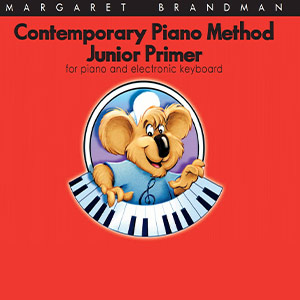
The Junior Primer is designed for the 5 to 12 age group, although it works equally well with novice adult learners. It contains all the skills required to play with both hands simultaneously on the instrument, encouraging the reading of music by intervals, shapes and patterns.
Among the many features of the book are: enjoyable written exercises and puzzles, graphic boxes to be colored in to teach rhythm, improvisation suggestions, transposition, and catchy songs to play.
What Teachers Are Saying
"The Junior Primer is one of the best primers on the market and any beginner of piano would benefit greatly from the content and high level of skills it encourages from the outset."
"Margaret, in the other Alfred's books they label intervals as step, skip then fourth and fifth...this creates enormous confusion for the kids. In these books I am not sure I agree with switching from one hand to another within the same piece with no landmark notes to help you get there. It has its pluses but I am still sold on your intervallic reading approach (and so are the students....they are quite adept sight readers these days)."
"Since I finally received a long-waited piano method of yours, I've been studying it. And every page I turn makes me smile as I find lots of features that I've hoped for in piano methods for a long time are actually in there! Especially the idea of musical ladder which I've done it myself(!) to visualise the piano keyboard high and low as we all know it's confusing for kids as reading direction and keyboard direction are different when it goes down. And also the interval reading method. I think it's very important to be able to see and hear the interval as you read music especially for little kids. And also as you point out for improvising, which I'm hopeless with. I wish I'd studied with your method when I started piano lessons when I was 4!"
Overall Objectives
The overall objective of this book is to familiarize the young student with the intervals up to a Fifth or jump and the note values of whole, half and quarter notes. The book also aims to impart a sense of direction, i.e. Up, Down, Contrary Motion In or Out, and most of the pieces use identical intervals in both hands.
For new users, the concepts are illustrated in the Contemporary Piano Method DVD. For the complete learning experience, The Contemporary Aural Course Preparatory Set (Book and Audio) should be used in conjunction with the book, for opportunities to listen to and reinforce the concepts of the Piano Method.
Course Sections
1 Getting to Know the Basics
This foundational section introduces students to essential piano concepts:
- Seating and Hand Position
- Parts of the Piano
- High and Low sounds
- Improvisation
- Playing tunes from Graphic notation
- Interval recognition - aural, visual and tactile
- Same (repetition), Step (second) and Skip (third)
- Rhythm Training through color
- The meaning of Staff, Clef, etc.
2 Reading, Listening, and Playing - Same and Step
Here the student learns to play pieces using the knowledge gained in Section 1. Each page has written activities to consolidate the concept being taught and a short piece to play.
The material in this section is for not only separate handed playing but also for both hands playing concurrently, facilitated by the use of direction concepts. Duets are provided and lyrics to sing, all illustrated with pictures of Dexter the Koala.
3 Reading, Listening and Playing - Skips Review
The tunes in this section explore these intervals, and the note and rest values of whole, half and quarter. The songs require students to play the same types of intervals in each hand whilst experience is given in reading the direction in which both hands are moving.
4 Skip-Plus-Ones (4ths) and Jumps (5ths)
The fun way to learn the look, feel and sound of these intervals through catchy tunes. The tunes require some differentiation of tasks, for coordination and independence.
The Contemporary Piano Method Book 1A is recommended for use alongside this section of the book, to provide extra practice in music speed reading of these intervals. Students can then graduate to level one of the course.
Guide Notes for Teachers
Beginner Level (Red Level) Teaching Kit
- Junior Primer
- Contemporary Theory Primer
- Contemporary Aural Course - Preparatory Level
- Junior Trax
Key: CPM 1A - Contemporary Piano Method Book 1A | CPM 3 - Contemporary Piano Method Book 3
Lesson one should encompass pages 5-13
Page 5 Parts of the Piano
Depending on the age and comprehension of your student, more details as to the workings of the damper mechanism and other parts of the piano could be given to the student. Refer to: CPM 1A page 6.
Page 6 Hand and Seating Positions
For more details on hand and seating positions as well as a basic introductory technique, refer to Contemporary Piano Method DVD/Video: (8.06, 9.03, 11.30)
Page 7 Finger Numbers
First demonstrate with both hands fingers 1 through 5 so that students realise the parallels in the fingering system. Next, play a game with your student asking him or her to point the required finger in the air, using either left or right hands. This also helps to reinforce the concepts of right and left.
Page 12 Improvisation
Mimic animal sounds - using high, low or middle range notes. Continue the call and response theme to allow children to develop longer improvisations.
Page 12 Ear-training Actions
A suggestion at this point, is to ask the child to do the actions to the sounds, similar to the pictures of Dexter the Koala, reaching high, touching toes or patting their tummies for middle-range notes. Likewise, they can stretch from low to high or vice-versa as the teacher sounds a series of notes moving in one direction. This can be practised at home while listening to Lesson One of the Contemporary Aural Course, Preparatory Set.
- Low koala - dark blue
- Middle koala - red
- High koala - yellow
- For the five rising koalas on page 13 - From Low to High - Blue, Green, Red, Orange, Yellow. Reverse colours for descending koalas.
Page 12 Lesson Activities
Spend 5 minutes or so each lesson on improvisation, ear-training actions, gross motor and fine motor drills and/or clapping so as to make each lesson as interesting and engaging as possible.
Page 14 Simple Interval Language
To simplify the interval reading process in the early stages of learning, the names Same, Step, Skip, Skip-plus-one and Jump have been given to the intervals in preference to the numerical sizes, thereby connecting the look of the interval with familiar language related to physical movements. This connects the look, the feel, and the sound of the intervals.
The language also avoids many of the difficulties when using the numerical sizes, for example: the concept of a unison or prime being a 'first'. Students often erroneously think that a step would be a first and a skip - a second. (Recently, the AMEB has produced the new Music Craft syllabus which also begins with the easy language of Step and Skip.)
Students should colour Dexter the Koala's clothes in the above colours each time they appear on this page and the following pages in the book.
Page 15 Gross Motor Actions for Intervals
If you are able to locate a set of three steps near your studio, ask the child to climb the steps while calling out, or preferably singing the intervals. Say 'one' for the starting position and then walk-sing/say 'step up, step up.' As you reach the top step, sing 'same' as the child puts the other foot down. Then turn around and say 'step down, step down' till you reach the bottom position. Next turn the student around and walk-sing/say 'skip up', then 'same' (turn on top stair) and then walk-sing/say 'skip down' to take the student back down. (This is demonstrated on the CPM-DVD)
Page 15 Interval Drill Game
At this point it is wise to play the Interval Drill Game, as shown on the CPM DVD. Allow the student to place his or her five fingers of either hand over any five consecutive notes (i.e., a hand position). You could suggest they begin on one of the signpost notes (C or F). Beginning on the thumb, sound the note, then connect smoothly to notes which are steps up and down, to establish the feeling and the sound of these intervals. Once these are secure, extend the game to include skips and lastly sames.
As students do not have to concern themselves with reading music they will be able to play more involved patterns of intervals than this early stage of reading would allow. This drill therefore will aid the development of finger dexterity and co-ordination as well as solidly impressing on the student the concepts of direction and the intervals.
In future lessons, use the Interval Drill Game to develop co-ordination between the hands. Ask the student to play identical intervals in both hands, first in similar motion then in contrary motion. Use the drill game each time a new interval is introduced.
Page 17 Picture Songs
The Picture Songs in this book are designed to give students music which uses more intricate finger patterns than they can read at this time. This develops their technique and provides tune material to play until such time as reading skills are at a level to play more complicated tunes.
Note: Once the starting note has been sounded, do not repeat it, simply move on to the next intervals.
Page 21 onwards: Students should highlight the lower number of the time-signature using blue, to represent the quarter-note beat note.
Page 22 Colour Coding for the Signpost C's
The two C's to memorise at this point are Middle C in the treble clef and Middle C in the bass clef. Colour coding helps the memorisation process immensely. Write the C's in these colours in their memory positions on the staff, at the beginning of each line of music to be played from page 25 onward.
- For the treble clef middle C use red, representing a low female voice in the alto range.
- For the bass clef middle C use light blue, representing a high male voice in the tenor range.
Page 23 Colour Coding
The bass and treble clefs could also be coloured in blue and red respectively.
Page 24 Hand Positions
The hand positions introduced in this book are intended to help the student realise the location of the five consecutive notes to be played, in relation to the range of the entire piano keyboard. This will help them realise whether the sounds produced are low or high sounding notes. The hand positions are used as a guide until such time as the location of the starting notes, via the signpost notes and the fingering is secure. They do not need to be memorised.
Page 25 The Gestalt Approach
A unique feature of this method is the simplicity of combining several necessary aspects of music reading and performance into one neat package. By asking the students to say or preferably sing the direction, interval and counting, you are training all vital aspects of music - ear, eye, hand and voice and requiring full concentration on the task at hand. There will be no need for the student to watch their hands on the keyboard.
The learning procedure is as follows:
- Look carefully through the music to see whether the notes move up or down.
- Prepare to play, by pointing at the notes and saying the intervals, counting and direction.
- One 2 3 4, Step Up 2 3 4, Step Up 2 3 4, Step Down 2 3 4, Step Down 2 3 4 off.
- The students should then talk/sing the information as they play, saying the interval and direction when they see the asterisk. (*)
This is demonstrated on the CPM-DVD.
Page 28 Colour Coding for the Next Two Signpost C's
The two additional C's to memorise at this point are High C in the treble clef and Low C in the bass clef. Write the C's in these colours in their memory positions on the staff, at the beginning of each line of music to be played.
TREBLE CLEF
- High C - pink - representing a high female voice in the soprano singing range
- Middle C - continue to use red, representing a low female voice in the alto singing range
- Middle C - continue to use light blue representing a high male voice in the tenor range
- Low C - dark blue representing a low male voice in the bass singing range
Page 30 Practice Procedure for All Pieces Written for Hands Together
- Make sure students start on the correct signpost notes with the correct fingers.
- After preparing each piece by a talk/sing through, continue to sing the information as you play.
- Play separate hands before playing hands together.
Page 30 Gross Motor Actions
To help the hands co-ordinate students should use a small tilt of their head to the right or left to indicate the directions (up or down). As it is easier for the fingers to move in contrary motion than similar motion in the beginning stages, the head tilt helps the process of combining the movements when playing in similar motion. See the demonstration on the CPM DVD (43.07)
Page 32 Interval Reading and the Keyboard Note Names
The Contemporary Piano Method encourages the student to learn the keyboard names of the notes, but does not foster the learning of the note names on the staff, other than the signpost notes till a later stage. The intention is that when reading music, the most important feature to observe is the interval and the names of the notes are a by-product of this.
By reading in this manner:
- Both clefs can be approached in the same way
- Fingering for all the notes is not required and the ear is trained to listen for intervals
- The students do not need to watch their hands thereby leaving their focus on the following flow of notes to be read and played
If the note-name is needed for theory purposes, it can always be worked out using a map of the keyboard as on this page. Later on, all that is needed is the names of the notes in keyboard order (ABCDEFGABCDEFGetc). The note-naming exercises in the Contemporary Theory Workbook series are done this way.
Practice Procedure for Tunes in Contrary Motion Using Two-Count Notes
There are several ways your students can talk/sing the music through.
For separate hands:
- Saying either the interval, direction and the second count: One 2, St up 2, St up 2, St up 2 and so on
- Saying the interval and the second count only. e.g. One 2, St 2, St 2, St 2, and so on
- Saying the direction and the second count only. e.g.. One 2, Up 2, Up 2, Up 2, and so on
For hands together:
- Talk/sing the interval, combined direction and the second count: e.g.. One 2, Step out 2, Step out 2 Step out 2 | OR Step in 2 Step in 2 etc
- Talk/sing only the combined direction and the second count: e.g.. One 2, out 2, out 2 and so on
For all pieces on the next few pages, make sure your students understand the concepts by using:
- Gross Motor actions - broad actions copying the koala
- Fine Motor actions - touch the page and trace the directions with thumb and forefinger as shown on the CPM DVD.
Page 33 Transposition and Modal Sounds
This Picture Song can be transposed onto other areas of the keyboard by simply starting with a hand position on any of the other white notes, with the hands one octave apart. This means they may hear some modal sounds. For instance if the melody is played on the white notes beginning on A, the sound will be that of the Natural Minor scale or Aeolian Mode. If the melody is begun on E, the sound will be that of the Phrygian Mode etc. The written hand positions in the book which begin on F all give the sound of the Lydian Mode.
For more information on Modes, refer to CPM Bk3, and Contemporary Theory Workbook 2
Page 36 Shape and Pattern Reading - Song of Two Hills
Follow the flow by tracing the music with the fingers on the page. There are three ways to talk or sing through this piece:
- Say both steps and direction: step up, step up etc.
- Direction only: One, up, up, up, | up, down, down, down, | down, up etc (This is useful if the student wishes to play the piece more swiftly.)
- Say counting only: ask the student to play using counting only if they are already secure reading the intervals and the direction.
Once the student can play the intervals correctly they can begin counting four beats in the bar as is usually done.
Page 38 Finding Hand Positions
From this piece on students should find the hand-positions for themselves, working from the signpost note and the finger number and then placing the fingers accordingly. Sometimes the starting notes are to be judged as a distance from the signpost note. This is so that they become used to beginning on varied starting notes, not just C.
Page 38 Inserting the Second Count
Whenever a two count note appears in tunes which use a mixture of note values, the student needs to remember to say the second count, quite deliberately after saying the interval. To simplify this, the count '2' can be used, no matter whether the music is on the second beat of the bar, or the fourth beat of the bar. See also page 41, for an example of this.
Page 43 Steps and Sames
These two tunes revise steps and sames. In the second piece:
- Make sure that students are on the lookout for the skip.
- Emphasise the second count for the half notes.
Page 44 Cuing
This refers to the bracketed notes inserted at the beginning of bar 5 in this piece. Cuing may be used to help the beginning student become comfortable reading longer pieces which move to the next line (system) of music until such time as the eye movements are swift enough to cope with the larger physical distance between notes at the end of one line and the beginning of the next.
It is helpful for the teacher to copy the final notes of bar four as a cue, in front of the notes in the fifth bar, so that the student can more easily see the interval sizes as they are reading into the fifth bar. This has been demonstrated on this page, but teachers or students can add the cues for themselves if desired from now on.
Page 45 Supplementary Material
At this point it is advantageous to give the student some more tunes to play using right hand only. Several songs in Junior Trax are ideal for this level. The first one to use alongside pages 45-47 of the JP is Warm Kitty - on page 16. It uses the intervals and timing so far covered in the course.
Page 46 Long Legged Sailor
- Work out the starting notes for each hand from the Signpost C's.
- Finger-trace the directions noting the sections of similar and contrary motion.
- Notice the two-count rests.
Page 48 Supplementary Material
'Chop Sticks' is excellent supplementary material at this point, as it emphasises the sounds of harmonic steps and skips. Teach it by ear or by graphic notation, or refer to Hot Trax for the sheet music. Finger the piece using fingers 2, 3, 4 and 5 of each hand, fanning out from F and G starting notes.
Page 55 Supplementary Material
Junior Trax - Use the songs on pages 7 and 10 played with separate hands.
Transition to Level One (Yellow Level)
Coinciding with page 55 in the Junior Primer - Introduce the following practical and theory books gradually over a period of 2 to 3 weeks, while the remainder of the Junior Primer is being completed.
- Junior Trax - they should already be playing some of the tunes in this book single hands
- Contemporary Piano Method Book 1A
- Daily Dexter Flexers (including duet parts) for the younger child
- Dexter's Easy Piano Pieces (DEPP) for the older child who is progressing quickly, or for the younger child, introduce DEPP upon completion of Junior Trax
Contemporary Piano Method 1A
While completing the material in the Junior Primer from page 55 on, students are advised to commence Book 1A of the Contemporary Piano Method, from pp 14 & 15 where separate handed lines of music using mixtures of all the intervals are presented. This helps to consolidate and speed up the reading of all the intervals.
If a small amount of reading is set each lesson from pages 14 to 19 in Book 1A, concurrently with the final pages of the Junior Primer, the student will be ready to play the first piece with varying intervals in the method on page 21 as soon as the Junior Primer is completed. They will then also be able to play the two-handed pieces on page 5 of Junior Trax.
Daily Dexter Flexers
Begin playing a few exercises from Group One concurrently with the end of the Junior Primer. Set more, once the Junior Primer is completed.
Dexter's Easy Piano Pieces
Begin this book once pages 5 to 11 in Junior Trax have been completed. Commence with pages 7 and 8, plus Lightly Row (p9).
- Contemporary Theory Primer - continue one to two pages per week for homework
- Contemporary Theory Workbook 1 - begin this once page 21 of the CTP has been completed and then continue to work both books in tandem
- Contemporary Aural Course, Set One - move on to this set once the Preparatory Level is complete
Pages 58-60 Varying Intervals and Timings Between the Hands
The tunes on these three pages present the task of playing varying intervals and timings between the hands.
- 'What's the Matterhorn?' (Swiss Mountain Climbing song), presents a group of repeated notes against varying intervals.
- Traffic Lights and Johnny Works with One Hammer require the student to sustain longer notes in one hand while playing shorter values with the other.
Continuing practice in these new skills is presented in the first pages of Junior Trax (p5, 6 & 7).
Junior Trax
Junior Trax provides a gently graded and tuneful set of pieces which serve to consolidate and expand the skills learned in the Junior Primer. Refer to page 4 of JT for a chart of the skills covered in the book.
The included duet parts foster ensemble skills and rhythm training for the early level pianist. For best results use this book in tandem with the CPM Book 1.
Go to the Junior Trax page via the Jump list on this site, for information on the tunes arranged for Junior Trax.
The Junior Primer
The Junior Primer is designed for the 5 to 12 age group. It contains all the skills required to play with both hands simultaneously on the instrument, encouraging the reading of music by intervals, shapes and patterns.
Among the many features of the book are: the enjoyable written exercises and puzzles, the graphic boxes to be coloured in to teach rhythm, improvisation suggestions, transposition, and catchy songs to play.



Reviews
There are no reviews yet.